Cleowi curated discovery
Cozy Home Details That Make a Room Feel Finished
Make a room feel finished with layered lighting, repeated texture, practical storage, calmer surfaces and personal details that actually belong there.
There is a particular kind of unfinished room that has nothing obviously wrong with it. The sofa is there. The bed is made. The desk works. Yet the room still feels as if someone moved in last weekend.
Usually the missing piece is not another large purchase. It is the relationship between the smaller things: where the light comes from, what repeats, what is left out, and whether the objects you use every day have somewhere sensible to go.
Look at the room after sunset
Daylight forgives a lot. Evening light reveals the actual mood of a space.
If the only light source is a bright ceiling fixture, try turning it off and notice where you naturally want light instead: beside the sofa, on a desk, near the bed, or in a dark corner. Residential lighting guidance commonly separates light into ambient, task and accent layers. In practical terms, that means general light for moving through the room, focused light for things like reading or getting ready, and smaller light that gives the room depth.
You do not need all three in every corner. One table lamp can be enough to change a flat room because it brings the light lower and closer to where people actually sit.
For more lighting and small-space pieces, the Cleowi Home & Lifestyle category and Cozy Home Finds collection are useful reference points.
Repeat one texture instead of adding five
A cozy room is not a competition for the most blankets.
Pick two or three textures that already belong in the space and repeat them. Maybe it is washed cotton, warm wood and a nubby knit. Maybe it is glass, pale metal and velvet. Repetition is what makes separate objects read as a room rather than a pile of purchases.
The scale should change. If you have a large boucle chair, the room probably does not need a boucle cushion, boucle stool and boucle storage box. Echo the feeling without cloning the surface.
Make storage easier than leaving things out
Organization fails when putting something away takes more effort than dropping it on the nearest chair.
Keep daily items close to where they are used. A shallow tray by the door is better than a complicated drawer system across the room. A basket near the sofa can hold the blanket that otherwise lives on the floor. A small organizer at a vanity is useful if the products inside are the ones you actually reach for.
Before buying more storage, remove obvious duplicates and things you do not use. A prettier container cannot solve too many belongings.
Style one surface, leave another one alone
Not every table needs a vignette.
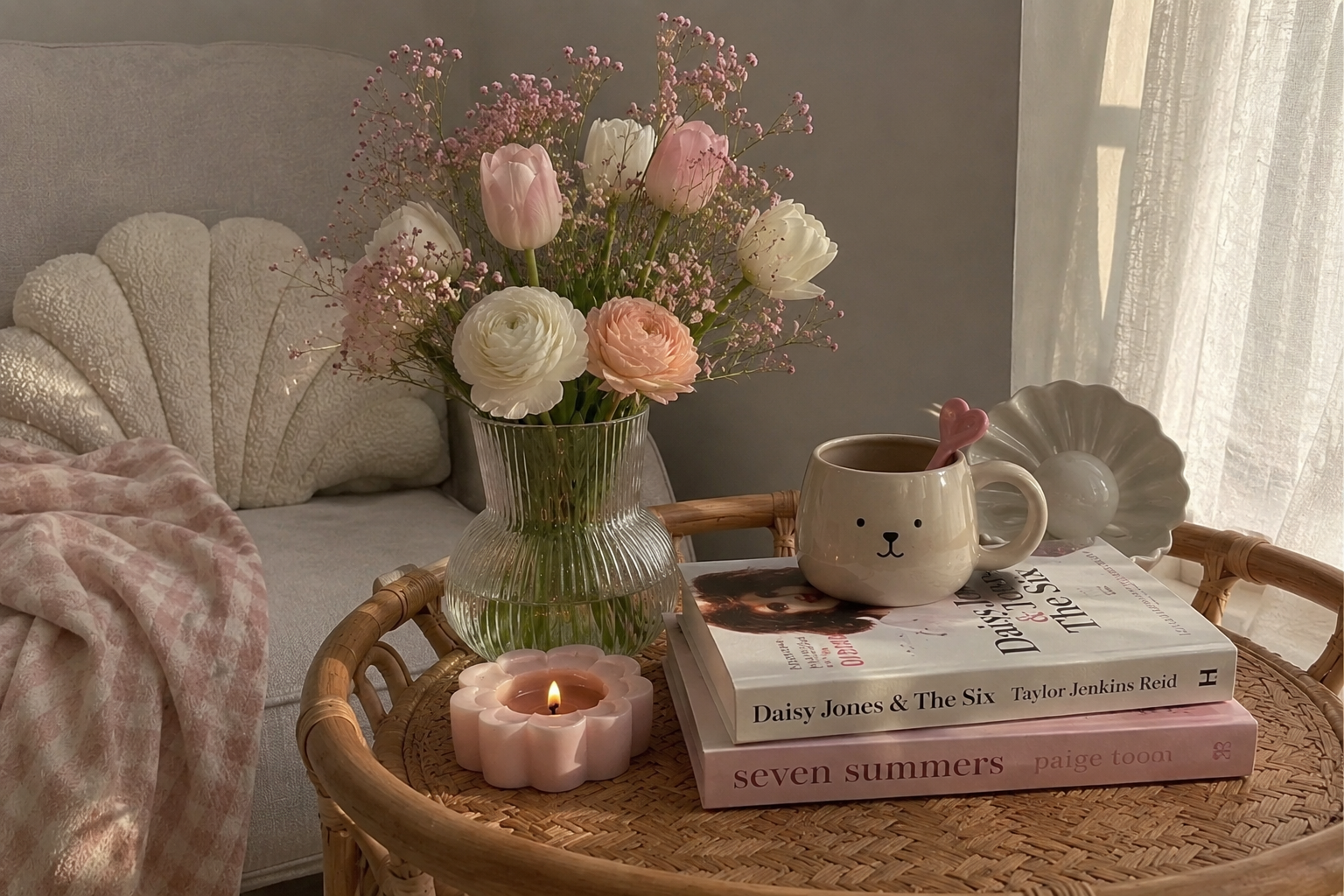
Choose the surface people naturally see first and give it a little structure: one useful object, one taller object, perhaps a book or tray, and some breathing room. Then let another nearby surface stay mostly empty.
The contrast makes the styled area look deliberate. It also gives you somewhere to put a cup without moving a decorative sculpture first.
Let the room have one odd thing
Rooms copied too literally from moodboards can become strangely anonymous.
Keep something that is not perfectly “on theme”: a funny object, a worn book, a framed print from a trip, a color that appears nowhere else, an inherited piece. Personal objects create visual tension in the same way an unexpected shoe can improve an outfit.
That does not mean displaying everything meaningful at once. Pick the things that still make you stop for half a second when you see them.
Use scent as atmosphere, not camouflage
Candles and home fragrance can change the feeling of a room, but they should not be used to cover an actual odor problem. Fresh air, clean textiles and taking out the source come first.
If you use candles, follow the maker's safety directions, keep flame away from fabric and never leave a burning candle unattended. One scent direction is usually enough for a small room; several competing fragrances can make the space feel busier rather than calmer.
Try the one-hour reset before you shop
If a room feels unresolved, do not redesign it. Give yourself one hour.
Move one light source. Clear one surface. Put everyday clutter into a useful container. Repeat one color or texture that is already in the room. Remove one decorative object that is only there because the space looked empty.
Then live with it for a few days.
A finished room is not a room with no blank spaces. It is a room where the practical things are easy to use and the decorative things look as though they have a reason to be there.